
LaPlace City Directory Shelves
No official catalog reviewed lists a complete, year-by-year residential city directory run for LaPlace. That absence matters. It is safer to ask for an exact town, year, publisher, and arrangement than to assume a New Orleans volume covers the River Parishes. The confirmed collections below offer several useful paths, but each has a different scope. Some are true directory categories, while others provide geographic or public-agency context.
| Collection | Years | Where Held | Access |
|---|---|---|---|
| State government telephone directories | 2003 through at least 2022 | State Library ContentDM | Public PDFs; agency entries, not households |
| Historic city and telephone directory category | Exact LaPlace years unconfirmed | Louisiana Collection | Ask State Library reference staff |
| Genealogy databases | Provider coverage varies | St. John Parish Library | Some resources require an in-library visit |
| Reverse-directory holdings guide | New Orleans 1966-1995; no LaPlace run confirmed | Library of Congress | Catalog and methods online |
| Colonial Original Acts | 1753-1798 | State Archives, with Clerk permission | Microfilm collection S2003-027 |
The most productive request describes what is sought without overstating what exists: “residential or telephone directory for LaPlace or St. John the Baptist Parish, near 1975, alphabetical or reverse order.” Ask whether the item is on paper, microfilm, or a database. If no local edition exists, request River Parishes coverage and note every catalog response.
LaPlace Library Directory Access
The St. John Parish Library resource page is the best local starting point. The Norris J. Millet branch at 2920 Highway 51 lists 985-652-6857, Monday through Thursday from 9 a.m. to 8 p.m., and Friday and Saturday from 9 a.m. to 5 p.m. Its page also notes rebuilding and redesign work after Hurricane Ida, so call before a visit that depends on a specific machine or shelf item.
Ancestry Library includes census, vital, immigration, military, court, directory, map, and photo material, but access is limited to the library setting. HeritageQuest adds census, tax, land, probate, directory, and local-history sources. HeritageHub and NewsBank cover obituaries and death notices from 1704 to the present at the provider level. None of those descriptions guarantees a particular LaPlace volume. Staff can help test the catalog, database title list, and spelling variants.

The captured resource screen helps identify which database to open before narrowing the search to LaPlace, St. John Parish, and the target year.
Statewide Help for LaPlace Directories
The Louisiana State Library collections provide the broader fallback. Its Louisiana Collection began in 1947 and now contains directories, genealogy, maps, WPA files, photographs, newspapers, and clippings among more than two million items. More than 35,000 items are digital. Reference staff list ill@state.lib.la.us, 225-342-4914, and public service hours of 10 a.m. to 2 p.m., Monday through Thursday.
Give staff a name, date range, place label, and desired arrangement. “LaPlace,” “St. John the Baptist Parish,” and nearby postal communities may index differently. A negative catalog result is useful evidence, not a reason to substitute an unrelated local volume. Ask staff to check old phone books as well as the historical-directory category and to report call numbers for any onsite item.
A Dated LaPlace Directory Series
The confirmed ContentDM run is a series of Louisiana State Government Telephone Directories from 2003 through at least 2022. The 2018 edition, dated April 26, places its LaPlace section on page 53. It lists public-agency anchors on West Airline Highway, Belle Terre Boulevard, Cambridge Drive, and Bert Street. These entries can show when an agency used an address and phone number.
This is not a residential name list. Do not use it to infer a private household. Its value lies in dating offices and recognizing older place references that appear in correspondence, obituaries, or family papers. Compare the edition date and page number, then verify the agency through a newer official source if the goal is current contact.
| Record | Louisiana State Government Telephone Directory |
|---|---|
| Confirmed item | 2018 edition, item 34086 |
| LaPlace section | Page 53 |
| Best use | Date a public office or agency address |
| Not proof of | Private residence or present occupancy |
LaPlace Records Across Time
The surviving sources form a timeline even without a complete residential run. Each point marks a change in where useful names, places, or addresses may be found. It does not claim continuous coverage between the dates.
| Date | LaPlace and St. John research milestone |
|---|---|
| 1718-1825 | Catholic sacramental material is identified in published books and archive or library holdings. |
| 1753-1798 | St. John Colonial Original Acts cover property, succession, and civil matters. |
| 1947 | The State Library's Louisiana Collection was formed. |
| 1966 | St. John Parish Library began serving the parish. |
| 2003-2022 | The confirmed state government telephone-directory series spans at least these years. |
| July 2024 | The Leroy D. Williams branch opened in Reserve while other parish branches continued rebuilding or redesign work. |
This sequence helps choose a custodian. Early family research belongs with church books, Original Acts, and archives. Twentieth-century questions may move to library catalogs, newspapers, census sources, and old telephone books. Recent agency addresses can use the state government series, while a current address requires assessor, GIS, and Clerk records rather than a historical directory.
Read LaPlace Directory Entries Carefully
No residential LaPlace sample page was exposed in the official collections inspected. That means abbreviations, ownership marks, and spouse formats cannot be claimed for a specific local publisher. When a permitted entry is found, record the edition and page first, then transcribe only the fields needed for the research question. Photograph the abbreviation key when rules allow because one letter can change the meaning of an entry.
| Source identity | Publication title, publisher, edition, year, page, and call number or URL |
|---|---|
| Personal entry | Name spelling, spouse or former-name notation, and listed trade or agency |
| Place entry | Street address and any ownership, renter, or widow notation actually defined by the volume |
| Arrangement | Alphabetical, telephone, or address-order section |
| Cross-check | Adjacent directory year, census year, obituary, land, or probate source |
- Criss-cross directory
- A directory arranged by street address rather than only by a person's name.
- Householder index
- A list centered on the person identified as the head or main listed member of a household.
- Abbreviation key
- The publisher's legend for shortened words and symbols; its definitions control how an entry should be read.
LaPlace Names Need a Crosswalk
The State Library's Louisiana Directory of Cities, Towns and Villages is a place guide, not a list of people. It links LaPlace to ZIP 70068 and gives older population figures, while also showing Edgard, Garyville, Reserve, Wallace, Lions, and Mount Airy with their postal labels. Most important, it places Montz in neighboring St. Charles Parish while showing a LaPlace postal place and ZIP 70068.
That is a practical warning for local directory work. A LaPlace mailing label does not by itself prove St. John Parish jurisdiction. Check the date, community name, parish, and street before assigning an entry to a family. For older material, try the postal place and civil parish as separate catalog terms.
Before LaPlace City Directories
For families who predate usable city directories, the record trail shifts. State Archives microfilm lists St. John Colonial Records in the 1760s through 1798 range and Original Acts from 1753 through 1798. The acts can concern property, successions, and civil matters. They were microfilmed in 1964 as collection S2003-027, and the Clerk retains custodial authority. Obtain permission before arranging to view the film.
German Acadian Coast Historical and Genealogical Society resources add a church-record custody ladder. Catholic sacramental records for 1718-1825 appear in published books and archives or libraries; records for 1826-1900 route to Archdiocesan Archives, while later requests go to individual churches. The society is a research lead, not the civil-record custodian.
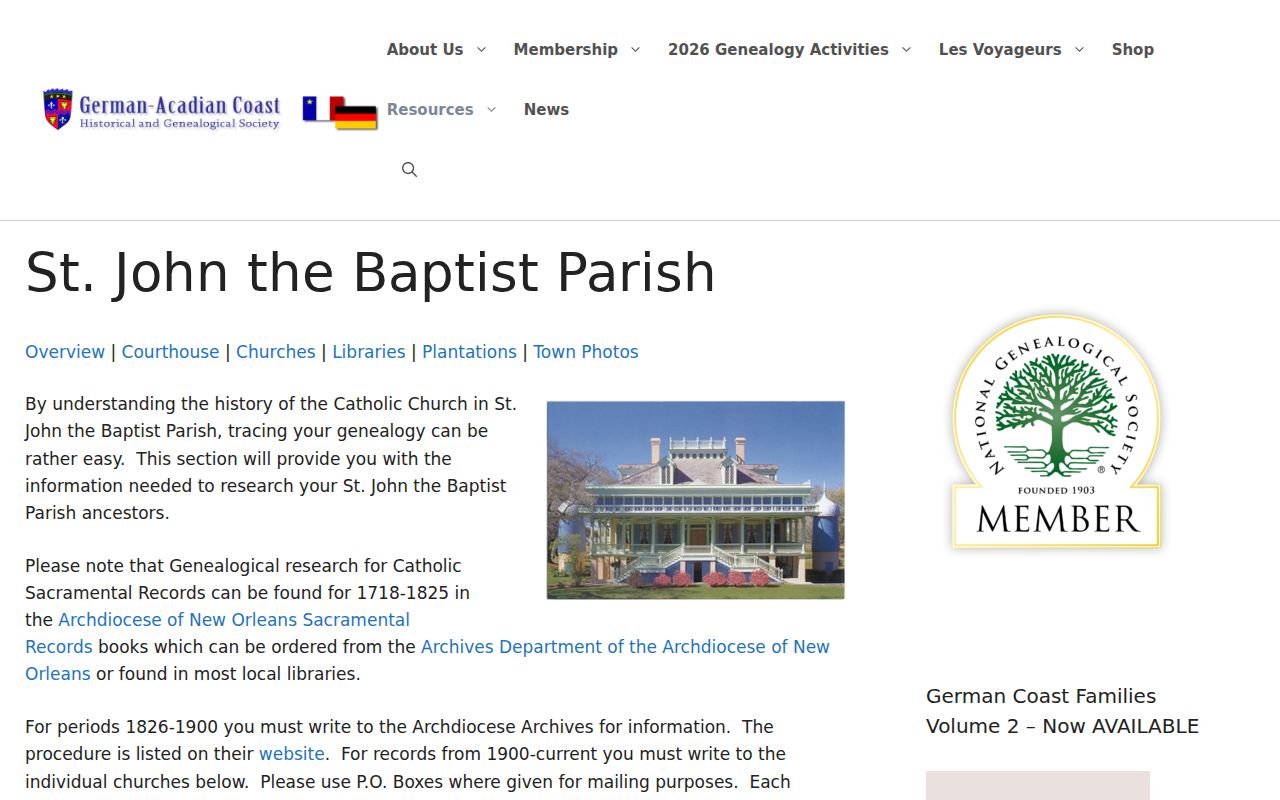
The resource image shows why early LaPlace family work often moves from directories to church, archive, and parish sources.
Trace Families in LaPlace Directories
A historical volume gives a dated clue, not a complete life story. Preserve the citation before building the timeline. Search name variants, including initials, married names, and spelling shifts. Then compare the address and household against a nearby census year, an obituary, a deed, or a church record. The aim is a chain of independent sources that agrees on place and time.
- Find the earliest supported entry, then save its full title, year, page, and collection location.
- Check the next available edition for the same name and address, while recording gaps rather than guessing.
- Use an address-order section, if the volume has one, to test the street and nearby household names.
- Pair the directory date with the nearest public census and the library's genealogy databases.
- Close the trail with an obituary, church record, succession, deed, or cemetery source.
A disappearance can mean a move, death, missed canvass, changed name, or a volume gap. HeritageHub may supply a death notice, and a deed or succession can explain a property change. If the goal turns from the historic shelf to a modern address, use the LaPlace street directory workflow rather than treating an old listing as present residence.